



 Previous
 Next
NextSocial and relationship capital
Click or tap for a larger version of this image


OUR KEY RELATIONSHIPS
The Group recognises that in order to create sustainable value for all it needs to be responsive to the expectations of all stakeholders. To meet the expectations of our stakeholders the Group engages in regularly with all stakeholders to establish a relationship of trust and respect to achieve favourable outcomes for all stakeholders on issues of mutual interest.
Further information detailing the expectation of stakeholders and the Groups strategic response thereto is provided here in this report. Additional information can also be found in the Sustainability Report available on our website at www.hulamin.co.za.
INVESTMENT IN OUR COMMUNITIES
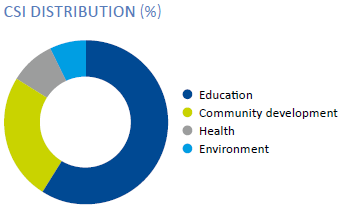
Corporate Social Investment (CSI)
The Group is steadfast in its vision to make a meaningful contribution to the Pietermaritzburg community. The Group recognises that it is situated in a society with enormous challenges and that the Group is symbiotically linked to the socio-economic and natural environment in which the company is located. The Group is therefore obligated in playing a leadership role in those areas within its sphere of influence.
During the past 12-months the Group contributed R4,1 million towards various CSI initiatives.
INVESTMENT IN OUR SUPPLIERS
Preferential procurement
The Group promotes the economic empowerment of black South Africans and encourages business relationships with other companies, which actively pursue sound employment equity and black economic empowerment programs and who will endeavour not only to support the new B-BBEE codes but to actively better their scoring on a on an ongoing basis.
The Group’s intervention program of preferential procurement is committed to achieving the objectives of growing the economic involvement in mainstream business, on a sustainable basis, of all previously disadvantaged groups. The Group promotes the development of black owned businesses and in particular wholly African owned entities, or majority African owned entities, as preferred suppliers, especially those that are both owned operated by and managed by Africans.
In order to achieve the strategy the Group has established an ESD committee. For further information on the objectives of the committee refer to our Sustainability Report available on our website at www.hulamin.co.za.
The revised B-BBEE codes continue to have an impact on the Group’s preferential procurement score as approximately 70% of the Group’s total measureable spend relates to incoming aluminium (raw material). The sole source of supply of primary ingot and rolling slab are B-BBEE level 5 and non-compliant respectively, with no verified black ownership, resulting in very little B-BBEE recognition for more than two thirds of its procurement spend. The Group is unable to achieve an acceptable preferential procurement score as almost no points are achieved from these two key entities. Hulamin has made significant progress on driving procurement from black owned EMEs and QSEs in the remaining 30% of its spend and as a result of this focus expects to achieve the sub-minimum 10 points for preferential procurement in its 2018 scorecard.
Over the last 12-months the Group spent R4,9 billion with B-BBEE enterprises. Within this amount:
- R523,1 million was spent on qualifying small enterprises (QSE);
- R478,0 million was spent on emerging micro-enterprises (EME);
- R1,3 billion was spent with enterprises which were at least 51% black owned; and
- R388,1 million was spent with enterprises where black woman owned more than 30%.
Enterprise development
The Group’s objective is to facilitate the development of sustainable businesses that will create jobs and add stimulus to the economy. In an effort to achieve this objective the Group has implemented strategic objectives which, among other, include:
- Favourable payment terms to emerging SD beneficiaries,
- Monetary and non-monetary support for black enterprises including supporting enterprise development agencies such as the Business Support Centre, and
- Management and time devoted towards conceptualising, guiding and rolling out various elements of supplier development.
The various initiatives put in place by the Group for enterprise development and supplier development amounted to Rx million committed during the past 12-months. The spend includes grant and loan funding contributions, shorter payment term benefits, senior management involvement in ESD activities and third party support costs in the form of developmental assessments, advice and mentorship and certain administrative support functions.
ZCN BUSINESS ENTERPRISE
ZCN Business Enterprise and Hulamin established a relationship under the ESD framework that enlisted ZCN as a beneficiary for skills transfer in the hygiene services category. In terms of the supplier development support provided, ZCN was granted a three-year skills transfer agreement in collaboration with a leading service provider in the industry (Servest Hygiene) to allow it to develop key skills and experience in the category and to gain an appreciation for the market dynamics within the hygiene services industry.
Due to the business acumen attained during the three-year programme, and as part of the graduation process, ZCN has been awarded the provision of the hygiene services for Hulamin’s core operating division; Hulamin Operations

