



 Previous
 Next
NextRemuneration and nomination committee report
Part a:
The chairperson’s statement
Part b:
The forward-looking remuneration policy
Part c:
The implementation of the 2018 remuneration policy
Composition of the committee:
Chairman (remuneration):
NNA Matyumza
Chairman (nominations):
ME Mkwanazi (until 26 april 2018)
TP Leeuw (from 26 april 2018)
Other members:
CA Boles
GH Watson
Part a:
Dear Shareholders
It is with pleasure that I present to you the remuneration report for the 2018 financial year on behalf of the Remuneration and Nomination Committee (“Remco”). The purpose of this report is to provide the stakeholders with a detailed summary of the organization-wide philosophy and policy pertaining to remuneration at Hulamin Limited (“Hulamin” or the “company”). In accordance with Hulamin’s dedication to being a responsible corporate citizen, this report has been aligned to follow best practice reporting standards incorporating the King IV Report on Corporate Governance (“King IV”) and the Johannesburg Stock Exchange (“JSE”) Listings Requirements.
Despite difficult local and international market conditions, and the volatile South African currency, Hulamin delivered a strong manufacturing performance with best-ever production and sales volumes. In this context, the total STI bonus paid was limited by the business not achieving certain financial performance targets. The 2015 share appreciation right scheme (“SARS”) award scheduled to vest in 2018 did not vest as a result of missing financial performance targets in 2017.
REMCO FOCUS AREAS 2018
In addition to its normal responsibilities, the Remco was faced with challenging policy changes, particularly in relation to the implementation of new corporate governance principles and amended JSE Listings Requirements.




The Remco has obtained the support, advice and opinions of external advisors on various remuneration-related matters. The Remco is satisfied with the constructive, objective and independent advice received.
MANAGEMENT REMUNERATION – A DYNAMIC CONTEXT
Issues around executive remuneration, disparities in pay and transparent disclosure remain topics with widely diverse opinions in South Africa. Cognisant of these issues, the Remco has continued to implement initiatives and policy changes in line with King IV and the JSE Listings Requirements.
With the introduction of the new ECSP in 2018, the previous 2007 schemes (SARS, long-term incentive plan (“LTIP”), and deferred bonus plan (“DBP”)) were discontinued, and no further awards will be made under these old schemes.
In addressing the requirements of the Employment Equity Act 55 of 1998 with regards the principle of equal pay for work of equal value, the Remco has initiated a Fair and Ethical Pay framework. In addition to this, when annual salary increments are applied, adjustments are weighted in favour of employees at lower remuneration levels.
In line with best practice, King IV and the JSE Listings Requirements, we will continue to submit the remuneration policy (part B) and the implementation report (part C) for separate, non-binding advisory votes at AGMs.
SHAREHOLDER ENGAGEMENT
In line with best practice and our value of remuneration being aligned with shareholders and their interests, we regularly engage with shareholders, in 2018 specifically on the design of the revised long-term incentive scheme.
APPRECIATION
The Remco is satisfied that we properly executed our duties in terms of our mandate for FY2018. At the AGM held on 26 April 2018, Hulamin received a 98.55% non-binding advisory vote in favour of both its remuneration policy and implementation report.
We would therefore like to thank our shareholders for their ongoing support as we continually seek to align shareholder interests and remuneration. We at Hulamin and, particularly, the Remco, are steadily continuing on the journey of implementing best practice standards in our remuneration reporting and disclosure.
NNA Matyumza
Chairman of the Remuneration and Nomination Committee
PART B: THE FORWARD-LOOKING REMUNERATION POLICY
The Remco is a subcommittee of the Board of the company (the “Board”) with delegated authority. Hulamin’s remuneration policy is reviewed annually by the Remco and submitted for approval by the Board. The Remco responsibilities and actions are set out and governed in its terms of reference, read together with Hulamin’s remuneration policy and other applicable documents.
The Remco meets at least three times per annum. The Remco members and their meeting attendance record is detailed below:
| Member | 6 Feb Scheduled |
22 Feb Special |
14 Jun Scheduled |
8 Nov Scheduled |
5 Dec Special |
| NNA Matyumza | ✔ | ✔ | ✔ | ✔ | ✔ |
| CA Boles | ✔ | ✔ | ✔ | ✔ | ✔ |
| TP Leeuw (from 26 April 2018) | N/A | N/A | ✔ | ✔ | ✔ |
| ME Mkwanazi (to 26 April 2018) | ✔ | ✔ | N/A | N/A | N/A |
| GH Watson | ✔ | ✔ | ✔ | ✔ | ✔ |
In 2018, scheduled Remco meetings were held on 6 February, 14 June, and 8 November. In addition to the scheduled meetings, Special Remco meetings were held on 22 February and 5 December, shortly before Board meetings, in order to approve recommendations to the board.
Invitees from management who are invited to attend Remco meetings are excused when their respective remuneration is discussed and they also do not take part in any voiting at the Remco meeting.
REMUNERATION PHILOSOPHY
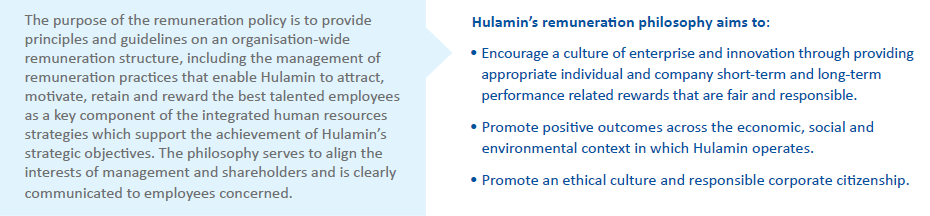
Hulamin’s remuneration philosophy is aligned with the principle of “pay for performance” within the boundaries of the company’s risk appetite, while avoiding the risks associated with undue windfalls or penalisation as a result of factors outside of employees’ locus of control. Variable pay should be only partially affected by the performance of a particular operation in which an employee works where factors outside the employee’s control affect the company’s financial results (e.g. commodity price or currency fluctuations), so as to find a balance between alignment with shareholder interests and employee rewards.
FAIR AND RESPONSIBLE REMUNERATION
The Board, supported by the Remco, gives due consideration to the principle of fair and responsible remuneration. As there are wide ranging opinions on the topic, the Remco reviews and approves initiatives, policies and arrangements to give effect to this principle (in line with best practice and the company’s strategic objectives).
The Remco ensures that executive remuneration (including the remuneration of prescribed officers) is congruent with overall employee remuneration.
The Remco makes recommendations to- and assists the Board in taking the following actions:

In striving to be a responsible corporate citizen, the company continuously considers initiatives to support the principle of fair and responsible remuneration and improve the employment conditions of all employees within the company.
REMUNERATION MIX
Structure of packages
The quantum, structure, composition and mix of remuneration packages supports the company’s strategic objectives, is market related and is aimed at being competitive in the company’s industry. To this end market surveys are conducted annually and used as input where action is required to ensure above principles are applied fairly to all stakeholders.
The appropriate mix between guaranteed and variable pay (including the short- and long-term elements of remuneration) are reviewed by the Remco and the Board from time to time taking market trends into consideration. The Remco ensures that the variable components of remuneration are designed to ensure an appropriate level of risk to the company and its long term objectives, avoiding any possible over-dependence on its variable components.
Note that at lower salary levels, the on-target remuneration mix is weighted towards TGP. and that variable pay constitutes a smaller proportion of total remuneration.
Guaranteed pay (TGP)







Variable pay
Short-Term Incentive Bonus (STI)
The primary purpose of the STI is to serve as a motivator of performance. Refinements to the STI are considered from time-to-time to improve the efficacy of the scheme.
The STI is based on a combination of corporate financial targets, divisional operational targets and individual performance.
Financial performance conditions are based on an equal weighting of Board-approved annual budgets by division:
- Earnings before interest and taxes (“EBIT”); and
- Operational cash flow

Operational performance targets are based on the Board-approved annual budget by division:
- Sales volumes measured in tons intended to increase total sales.
- Manufacturing costs including employee costs, including overtime, discretionary costs and a “metals” component to encourage recycling of scrap metals.
- Rolling margins measured in USD per ton as a measure to improve quality of sales volumes.
- Overall recoveries as a percentage of throughput intended to improve efficiencies.
- Working capital as a percentage of revenue to reduce working capital.
- Safety performance.

Individual Key Performance Areas (“KPA”) address the achievement of strategic business objectives across the following general areas:
- Financial performance
- Budgetary/cost control
- Transformation
- Safety
- Risk management
The STI scheme consists of six different levels. The percentage of TGP payable under the six levels for on-target performance is reflected in the table opposite:
| Position | Grade | STI on-target % of TGP | STI STRECH % of TGP |
| CEO | FU | 60 | 150 |
| CFO | FL | 50 | 125 |
| Other executives | FL | 40 | 100 |
| Senior management | EU | 33 | 82.5 |
| Senior management | EL | 25 | 52.6 |
| Middle management | DU – DL2 | 15 | 37.5 |
In the event of early termination of employment due to resignation or dismissal, there is no entitlement to a bonus payment. In the case of retirement, retrenchment and death in service there is a pro rata entitlement, paid to the participant at the year-end along with other participants.
The payment of bonuses for each component of the respective awards is determined independently from the other components.
The weightings of the targets are as follows:
| Position | Grade | Financial performance | Operational performance | Safety performance | Individual performance |
| CEO | FU | 60% | 10% | 10% | 20% |
| CFO | FL | 50% | 20% | 10% | 20% |
| Executives | FL | 40% | 30% | 10% | 20% |
| Senior management | EU | 30% | 40% | 10% | 20% |
| Senior management | EL | 20% | 40% | 10% | 30% |
| Middle management | DU – DL2 | 10% | 40% | 10% | 40% |
The Remco and the Board have the discretion to decide on the payment or non-payment of performance incentive bonus awards.
Long-Term Incentives
(LTIs – Share Incentive Schemes)
The variable pay component of Hulamin’s remuneration packages is structured to include LTIs for executives and senior management that are market-related and linked to company performance.
The primary purpose of the LTIs is to incentivise employees to achieve the long-term objectives of the company, specifically objectives that have multi-year durations and to retain key talent.
Financial performance conditions are included in order to align with shareholder interests.
Equity-settled Conditional Share Plan (“ECSP”)
The company introduced a new LTI for executives and qualifying management in 2018, being the ECSP.
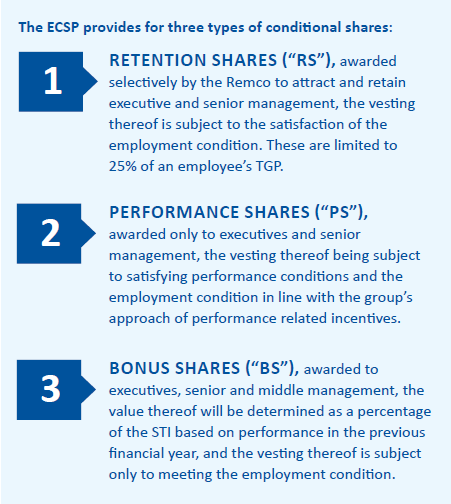
In line with best practice, regular annual awards of Bonus Shares and Performance Shares are made to ensure long-term shareholder value creation and alignment with acceptable market norms. In addition, the award of Retention Shares is for use in cases where there is a specific need to attract or retain talent.
Annual awards target a market-related level of remuneration whilst considering the overall affordability thereof to the company.
Bonus Shares are not subject to additional performance conditions due to the fact that they have an“entry performance requirement”, where the quantum of the Bonus Shares is determined with reference to the actual STI paid to the participant based on the prior financial year’s performance.
The extent and nature of performance conditions applicable to the Performance Shares awarded in terms of the ECSP are approved by the Remco annually and included in the award letter to participants.
Performance Share awards made to the participants are subject to the following performance conditions, measured over a three-year performance period:

Executives and senior managers may be offered annual LTI awards in terms of the annual allocation levels (as a % of TGP), based on the benchmarks set out below:
| Position | Grade | BS as % of TGP |
PS as % of TGP |
Total ECSP award value as % of TGP |
| CEO | FU | 24 | 36 | 60 |
| CFO | FL | 20 | 30 | 50 |
| Other executives | FL | 16 | 24 | 40 |
| Senior management | EU | 13 | 20 | 33 |
| Senior management | EL | 10 | – | 10 |
| Middle management | DU | 6 | – | 6 |
Dilution limit applicable to the ECSP
The ECSP is implemented within the shareholder approved dilution limit. The maximum aggregate number of shares that may be acquired by participants may not exceed 15 650 000 shares (5% of issued share capital), with the maximum for any one participant being 3 130 000 shares (1% of issued share capital).
The Remco will review the dilution limit usage and the headroom before an LTI award is made to ensure that the neither the company limit nor the individual limit is exceeded.
Manner of settlement of LTI awards
The rules provide for the following methods of settlement:
- Purchase shares off the market;
- Use of treasury shares;
- Issue new shares (within the dilution limit); and/or
- Cash settlement.
The company generally settles the awards through the purchase of shares in the market. The exact method of settlement is determined by the Remco with reference to the dilution limits and the business cycle.
Early termination of employment
Employees may be classified as either a “fault” leaver or a “no-fault” leaver depending on the circumstances whereby their employment is terminated. The provisions below apply to the ESCP as well as the legacy SARs.
The company generally settles the awards through the purchase of shares in the market. The exact method of settlement is determined by the Remco with reference to the dilution limits and the business cycle.
Early termination of employment
Employees may be classified as either a “fault” leaver or a “no-fault” leaver depending on the circumstances whereby their employment is terminated. The provisions below apply to the ESCP as well as the legacy SARs.


Legacy plans
Following the introduction of the ECSP in 2018, there remain a number of residual awards from Hulamin’s legacy plans for the time being – the SARS and the LTIP. No further grants will be made under the legacy plans.
The overall quantum of awards granted under the SARS and/or LTIP was determined by the Remco annually based on the LTI allocation methodology, taking into account relevant market trends, current business issues, and the limits contained in the rules and guidelines of the schemes.
The SARs were offered in the form of performance based conditional awards to eligible executives and senior managers. The performance conditions governing the vesting of the SARs were related to growth in headline earnings per share (relative to targets that were intended to be challenging but achievable), linked, to the company’s medium-term business plan, over three-year performance periods.
Under the LTIP, once-off shares were offered to executives and eligible senior employees in order to attract and retain top talent. These LTIP awards did not bear performance conditions, vested over a three-year period based on tenure and were specifically approved by the Remco.
2015 Employee Share Ownership Plan (“2015 ESOP”)
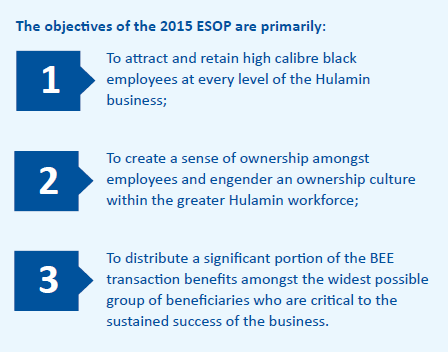
As Hulamin values its employees as key contributors to the ongoing performance and success of the business, all permanent South African based employees up to middle management (Paterson A band to lower D Band) and all permanent Black South African middle and senior management (Paterson upper D band and above) participate in the 2015 ESOP.
Participation is through two classes of “A” ordinary shares, 15% of which were issued with no strike price (“A1”) and 85% are appreciation rights (“A2”). During the vesting period both classes of share participate in dividends declared by the company. The A1 ordinary shares are entitled to a cash dividend, but for the A2 ordinary shares, the dividend is utilised to reduce the strike price of the right at the time of vesting.
Both classes of shares vest after five years. On vesting, the A1 ordinary shares will convert to Hulamin ordinary shares on a one-for-one basis. The appreciation of the A2 ordinary shares will be converted to Hulamin ordinary shares and the balance of the unvested portion of A2 ordinary shares bought back by the company at a nominal value.
EXECUTIVE CONDITIONS OF EMPLOYMENT
With the exception of notice periods, executives are employed under the same employment conditions as other staff.
The notice period for the CEO is no less than three months and the notice period for other executives is two months. Hulamin reserves the right to terminate an executive’s employment, without notice, for any cause recognised sufficient by law.
Executive employment contracts do not allow for payment of any additional benefits or balloon payments on termination, other than those of other staff employees.
In the event of early termination there is no automatic entitlement to bonuses or share-based incentives. Executives may, however, receive pro rata payment as allowed in terms of the “no-fault” provisions contained in the early termination clauses of the company’s incentive scheme rules.
In terms of executives’ employment contracts there is no automatic severance compensation to executives due to a change of control.
In such cases, the company’s retrenchment policy will apply.
NON-EXECUTIVE DIRECTORS’ (“NEDs”) FEES
NEDs receive fees for serving on the Board and Board committees and do not have service agreements with the company. NED fees are paid in cash on a fixed retainer basis and an attendance fee per meeting. The Board typically holds five Board meetings per year and there are typically three meetings for each of the sub-committees of the Board throughout a financial year.
Attendance at additional sub-committee meetings is remunerated at the standard remuneration rate for attendance at scheduled meetings of such committees. Attendance fees for ad hoc Board committee’s meetings are equivalent to those earned by members of the Remco. Disbursements for reasonable travel and subsistence expenses are reimbursed to NEDs in line with the reimbursement policy for employees.
Fees for NEDs are reviewed on an annual basis taking into account the responsibilities borne by NEDs as well as relevant external market data. Fees are recommended by the Remco and are submitted to the Board for approval, and finally recommended to the shareholders for approval at each AGM.
NEDs are to retain their independence and as such do not receive payments linked to the company’s performance nor do they participate in the company’s incentive schemes.
The proposed fees will be tabled before shareholders for approval by special resolution at the AGM on 25 April 2019:
Present fees to |
Proposed fees from |
||||
|---|---|---|---|---|---|
| Role | Annual retainer Rand |
Attendance per meeting Rand |
Annual retainer Rand |
Attendance per meeting Rand |
% change |
| Chairman of the Board | 454 680 | 38 970 | 477 410 | 40 920 | 5.0 |
| Member of the Board | 166 140 | 14 240 | 174 450 | 14 950 | 5.0 |
| Chairman of the audit committee | 119 570 | 17 080 | 125 550 | 17 930 | 5.0 |
| Member of the audit committee | 69 480 | 9 930 | 72 950 | 10 430 | 5.0 |
| Invitee of the audit committee | 9 930 | 10 430 | 5.0 | ||
| Chairman of the risk and safety, health and environment committee | 82 560 | 11 790 | 86 690 | 12 380 | 5.0 |
| Member of the risk and safety, health and environment committee | 45 310 | 6 480 | 47 580 | 6 800 | 5.0 |
| Invitee of the risk and safety, health and environment committee | 6 480 | 6 800 | 5.0 | ||
| Chairman of the Remco | 82 560 | 11 790 | 86 690 | 12 380 | 5.0 |
| Member of the Remco | 45 310 | 6 480 | 47 580 | 6 800 | 5.0 |
| Invitee of the Remco | 6 480 | 6 800 | 5.0 | ||
| Chairman of the transformation, social and ethics committee | 82 560 | 11 790 | 86 690 | 12 380 | 5.0 |
| Member of the transformation, social and ethics committee | 45 310 | 6 480 | 47 580 | 6 800 | 5.0 |
| Invitee of the transformation, social and ethics committee | 6 480 | 6 800 | 5.0 | ||
| Chairman of an ad hoc Board committee | 82 560 | 11 790 | – | 12 380 | 5.0 |
| Member of an ad hoc Board committee | 45 310 | 6 480 | – | 6 800 | 5.0 |
| Invitee of an ad hoc Board committee | 6 480 | 6 800 | 5.0 | ||
| Fees for international NEDs(€) | 30 797 | 2 638 | 31 320 | 2 680 | 1.6 |
| Fees for international NEDs ($) | 31 163 | 2 670 | 31 720 | 2 720 | 1.9 |
VOTING AND SHAREHOLDER ENGAGEMENT
Voting on the remuneration policy and implementation report
In line with best practice, King IV and the JSE Listings Requirements, the remuneration policy and the implementation report (as contained in the annual integrated report) must be tabled for two separate non-binding advisory votes by shareholders at the AGM.
Shareholder engagement
Hulamin is committed to fair, responsible and transparent remuneration and as such invites shareholders to engage with the company on remuneration-related matters.
In the event that 25% or more of the shareholders vote against either or both the remuneration policy, or the implementation report, the Remco will commence engagement with dissenting shareholders and ascertain their reasons and legitimate concerns underlying their votes. In order to do so, the Remco must extend an invitation to dissenting shareholders in the Stock Exchange News Service (“SENS”) announcement together with the results of the AGM, which invitation must include the manner, date and timing of engagement.

PART C:
THE IMPLEMENTATION OF THE 2017 REMUNERATION POLICY
This implementation report is subject to an advisory vote by shareholders at the AGM dated 25 April 2019.
TGP
The Remco approved an average salary increase mandate of 6.4% of cash salary for the executive, and 6.9% increase for other monthly paid employees. The weekly paid and artisan employees are subject to wage negotiations with the bargaining council. The Remco is satisfied that the increase levels for executive directors are in line with increase levels throughout the company.
STI OUTCOMES
The table below sets out the STI performance outcomes for 2018:
| Performance measure | Actual achievement % |
|---|---|
| Financial | 71.7 |
| Operational | 88.9 |
| Safety | 50.8 |
| Individual (average) | 96.8 |
The table below sets out the STIs the executive directors and prescribed officers were paid for the 2018 financial year, based on the achievement of performance targets, vs their possible STI awards for On-target company performance:
| On-target STI | FY2018 Actual STI | |||
|---|---|---|---|---|
| Participant | Rands | % of TGP |
Rands | % of TGP |
| RG Jacob (CEO) | 3 336 679 | 60 | 1 269 239 | 23 |
| AP Krull (CFO) | 2 069 804 | 50 | 933 026 | 23 |
| MZ Mkhize (executive director) |
1 581 654 | 40 | 1 037 249 | 26 |
| DR Weisz1 (prescribed officer) |
1 297 729 | 40 | 395 764 | 12 |
| HT Molale1
(prescribed officer) |
1 329 788 | 40 | 375 421 | 11 |
| 1 | HT Molale was prescribed officer to 28 February in his capacity as MD of Hulamin Extrusions. From 1 March, DR Weisz assumed the role of prescribed officer when taking over the role of MD of Hulamin Extrusions. Full STI bonus amounts are disclosed. |
LTI OUTCOMES
The 2015 SARS was due to vest in 2018, and consequently the performance condition was measured over the three-year performance period. The actual 2017 HEPS of 104 cps did not meet the required HEPS target of 137 cps and consequently the 2015 SARS award lapsed.
The 2015 LTIP PC award performance conditions were measured over the three-year performance period. The actual ROCE of 8.9% exceeded the minimum target performance and resulted in 57.5% vesting of the 50% ROCE performance condition. The TSR ranking of Hulamin over the three-year performance period resulted in 44.4% of the 50% TSR performance condition, resulting in a combined 50.96% vesting of the 2015 LTIP PC.
Both the 2015 DBP and LTIP NPC awards were not subject to performance conditions and vested after the three-year tenure condition was satisfied.
Unvested LTIs
The table below discloses the value of each executive director and prescribed officers’ LTIs, whether allocated, settled, or forfeited, as well as the indicative value of awards not yet settled.
| LTI scheme | Date awarded | Vesting date | Opening number | Granted during the year | Grant price Rand | Settled during the year | Lapsed during the year | Closing number | Cash value Rand | Indicative value Rand |
|
Executives |
|||||||||||
| RG Jacob (CEO) | DBP | 8 May 15 | 7 May 18 | 17 319 | – | 6.84 | 17 319 | 88 327 | – | ||
| SARS | 24 Apr 14 | 23 Apr 17 | 633 100 | 6.90 | – | 633 100 | – | ||||
| SARS | 23 Apr 15 | 22 Apr 18 | 396 925 | 8.20 | – | 396 925 | – | ||||
| SARS | 22 Apr 16 | 21 Apr 19 | 744 440 | 6.30 | – | 744 440 | – | ||||
| SARS | 26 Apr 17 | 25 Apr 20 | 604 005 | 6.50 | – | 604 005 | – | ||||
| LTIP PC | 23 Apr 15 | 22 Apr 18 | 146 625 | 8.20 | 146 625 | 388 544 | – | ||||
| LTIP NPC | 23 Apr 15 | 22 Apr 18 | 48 875 | 8.20 | 48 875 | 254 150 | – | ||||
| ECSP – PS | 26 Jul 18 | 25 Jul 21 | – | 321 279 | 6.22 | – | – | 321 279 | 1 410 415 | ||
| ECSP – BS | 26 Jul 18 | 25 Jul 21 | – | 117 649 | 6.22 | – | – | 117 649 | 516 479 | ||
| AP Krull (CFO) | LTIP NPC | 1 May 16 | 30 Apr 19 | 145 370 | 5.75 | – | 145 370 | – | |||
| SARS | 26 Apr 17 | 25 Apr 20 | 327 554 | 6.50 | – | 327 554 | – | ||||
| ECSP – PS | 26 Jul 18 | 25 Jul 21 | – | 199 660 | 6.22 | – | – | 199 660 | 876 507 | ||
| ECSP – BS | 26 Jul 18 | 25 Jul 21 | – | 78 538 | 6.22 | – | – | 78 538 | 344 782 | ||
| MZ Mkhize (Director) | SARS | 25 May 11 | 24 May 14 | 261 503 | 6.91 | 261 503 | – | ||||
| SARS | 25 Feb 13 | 21 Oct 15 | 241 172 | 4.56 | 241 172 | – | |||||
| SARS | 24 Apr 14 | 23 Apr 17 | 201 780 | 6.90 | – | 201 780 | – | ||||
| SARS | 23 Apr 15 | 22 Apr 18 | 138 555 | 8.20 | – | 138 555 | – | ||||
| SARS | 22 Apr 16 | 21 Apr 19 | 313 573 | 6.30 | – | 313 573 | – | ||||
| SARS | 26 Apr 17 | 25 Apr 20 | 304 817 | 6.50 | – | 304 817 | – | ||||
| LTIP PC | 23 Apr 15 | 22 Apr 18 | 61 030 | 8.20 | 61 030 | 161 725 | – | ||||
| LTIP NPC | 23 Apr 15 | 22 Apr 18 | 20 343 | 8.20 | 20 343 | – | 105 784 | – | |||
| ECSP – PS | 26 Jul 18 | 25 Jul 21 | – | 152 571 | 6.22 | – | – | 152 571 | 669 787 | ||
| ECSP – BS | 26 Jul 18 | 25 Jul 21 | – | 57 682 | 6.22 | – | – | 57 682 | 172 347 | ||
prescribed officers |
|||||||||||
HT Molale (MD HulaminExtrusions to28 February) |
SARS | 24 Apr 14 | 23 Apr 17 | 150 157 | 6.90 | – | 150 157 | – | |||
| SARS | 23 Apr 15 | 22 Apr 18 | 117 625 | 8.20 | – | 117 625 | – | – | |||
| SARS | 22 Apr 16 | 21 Apr 19 | 265 954 | 6.30 | – | 25 954 | 265 954 | – | |||
| SARS | 26 Apr 17 | 25 Apr 20 | 258 285 | 6.50 | – | 258 285 | – | ||||
| LTIP PC | 23 Apr 15 | 22 Apr 18 | 51 811 | 8.20 | 51 811 | 133 335 | – | ||||
| LTIP NPC | 23 Apr 15 | 22 Apr 18 | 17 270 | 8.20 | 17 270 | 89 804 | – | ||||
| ECSP – PS | 26 Jul 18 | 25 Jul 21 | – | 128 275 | 6.22 | – | – | 128 275 | 563 127 | ||
| ECSP – BS | 26 Jul 18 | 25 Jul 21 | – | 52 006 | 6.22 | – | – | 52 006 | 228 306 | ||
| ECSP – RS | 26 Jul 18 | 25 Jul 21 | – | 133 620 | 6.22 | – | – | 133 620 | 586 592 | ||
DR Weisz (MD HulaminExtrusions from 1 March) |
SARS | 24 Apr 14 | 23 Apr 17 | 170 607 | 6.90 | 170 607 | – | ||||
| SARS | 23 Apr 15 | 22 Apr 18 | 117 620 | 8.20 | – | 117 620 | – | – | |||
| SARS | 22 Apr 16 | 21 Apr 19 | 265 944 | 6.30 | – | 265 944 | – | ||||
| SARS | 26 Apr 17 | 25 Apr 20 | 258 032 | 6.50 | – | 258 032 | – | ||||
| LTIP PC | 23 Apr 15 | 22 Apr 18 | 51 811 | 8.20 | 51 809 | 137 290 | – | ||||
| LTIP NPC | 23 Apr 15 | 22 Apr 18 | 17 270 | 8.20 | 17 270 | 89 804 | – | ||||
| ECSP – PS | 26 Jul 18 | 25 Jul 21 | – | 125 183 | 6.22 | – | – | 125 183 | 549 553 | ||
| ECSP – BS | 26 Jul 18 | 25 Jul 21 | – | 39 259 | 6.22 | – | – | 39 259 | 172 347 | ||
EXECUTIVE REMUNERATION
The table below sets out the single figure remuneration (i.e. TGP (Basic salary and company contributions), STI and LTI) received by executive directors and prescribed officers in 2018 and 2017, respectively.
| Cash salary
Rands |
Company contributions Rands |
STI
Rands |
LTI
Rands |
Total
Rands |
|
| 2018 | |||||
|---|---|---|---|---|---|
| RG Jacob (executive) | 4 821 624 | 739 508 | 1 269 239 | 642 694 | 7 473 065 |
| AP Krull (executive) | 3 557 424 | 582 184 | 933 026 | – | 5 072 634 |
| MZ Mkhize (executive) | 3 310 776 | 643 359 | 1 037 249 | 267 509 | 5 258 893 |
| DR Weisz (prescribed officer) |
2 771 232 | 473 091 | 395 764 | 227 094 | 3 868 181 |
| HT Molale (prescribed officer) |
2 787 144 | 537 325 | 375 421 | 227 100 | 3 926 990 |
| Total | 17 248 200 | 2 975 468 | 4 010 699 | 1 364 397 | 25 599 763 |
| 2017 | |||||
| RG Jacob (executive) | 4 527 744 | 684 327 | 1 939 516 | 1 609 507 | 8 806 094 |
| AP Krull (executive) | 3 333 144 | 545 132 | 1 281 770 | – | 5 160 046 |
| MZ Mkhize (executive) | 3 102 228 | 602 334 | 943 774 | 598 066 | 5 246 402 |
| HT Molale (prescribed officer) |
2 629 668 | 505 292 | 782 612 | 445 059 | 4 362 631 |
| Total | 13 592 784 | 2 337 085 | 4 947 672 | 2 652 632 | 23 575 173 |
NED FEES
The table below sets out the fees paid to NEDs in 2018:
| Name | Retainer fees
2018 Rands |
Attendance fees
2018 Rands |
Total fees
2018 Rands |
|---|---|---|---|
| ME Mkwanazi | 198 380 | 108 520 | 306 900 |
| TP Leeuw | 488 378 | 195 590 | 683 968 |
| VN Khumalo | 262 615 | 144 160 | 406 775 |
| AT Nzimande | 100 215 | 25 780 | 125 995 |
| NNA Matyumza | 329 983 | 110 280 | 440 263 |
| SP Ngwenya | 205 022 | 74 240 | 279 262 |
| PH Staude | 262 615 | 89 990 | 352 605 |
| GHM Watson | 588 799 | 248 692 | 837 492 |
| N Maharajh | 297 972 | 101 370 | 399 342 |
| CA Boles | 250 437 | 118 840 | 369 277 |
| B Mehlomakulu | 209 387 | 88 080 | 297 467 |
| B Larson (note 5) | 442 126 | 189 827 | 631 953 |
| Total | 3 635 903 | 1 495 369 | 5 131 300 |
APPROVAL
This report was approved by the Remco on 14 February 2019 and the Board on 28 February 2019. The Remco as well as the Board are satisfied that there were no material deviations from the 2017 remuneration policy during the 2018 financial year.

