



 Previous
 Next
NextRisk management
introduction
The employment of an effective risk management process is critical to Hulamin achieving its strategic and operational goals, particularly in the current environment of change and uncertainty. Hulamin recognises that risk is intrinsic to the business and that there is a balance to be struck between managing risk and exploiting opportunities. The group’s response to identified risks includes acceptance, avoidance, transfer and mitigation, as informed by the group’s risk appetite and tolerance levels as shown in the diagram.
Click or tap for a larger version of this image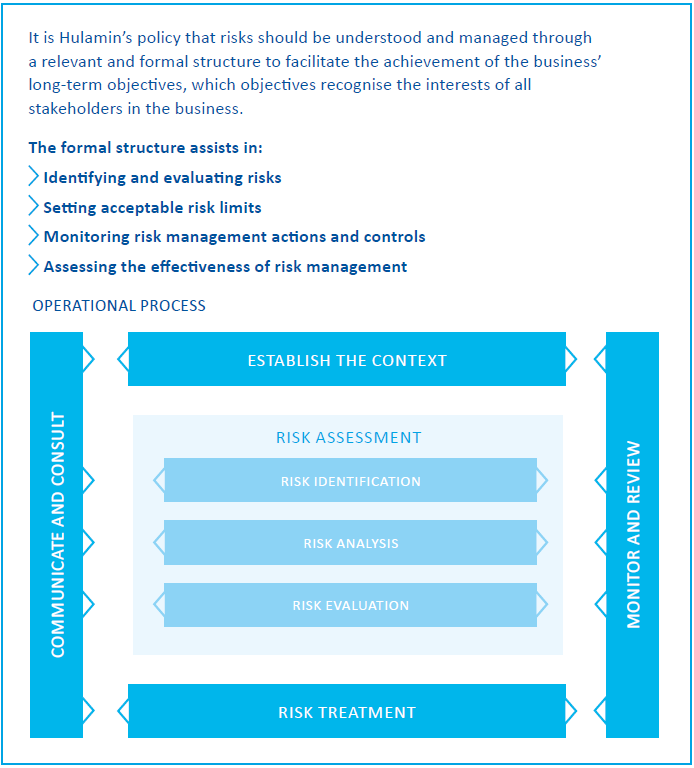
Risk management framework
Hulamin’s risk management framework provides the basis for the implementation of a consistent, efficient and economical approach to identify, evaluate and respond to key risks that may impact Hulamin’s objectives.
The framework also addresses the specific responsibilities and accountabilities for the Enterprise Risk Management (ERM) process and the reporting of risks and incidents at various levels within Hulamin. Hulamin’s risk management and governance structures, are aligned to its strategic and business objectives.
Click or tap for a larger version of this image
The framework, ISO 31000, which has been adopted by the group and assists Hulamin with:
- the aligning of its risk appetite and strategy;
- pursuing business objectives through transparent identification and management of acceptable risk;
- prioritising risks to ensure that resources and capital are focused on high-priority risks faced by the group;
- enhancing risk response decisions;
- reducing operational surprises and losses;
- identifying and managing multiple and cross-enterprise risks;
- seizing opportunities and developing strategic options;
- improving allocation and deployment of capital;
- ensuring compliance with laws and regulations; and
- increasing the probability of achieving objectives.
Risk management governance review
The board of Hulamin is ultimately responsible for the governance of risk of the group and assumes overall ownership thereof.
The board carries out its responsibilities for risk management via the Risk and the Strategy Committee which has oversight of the group’s enterprise risk management framework, policy and processes.
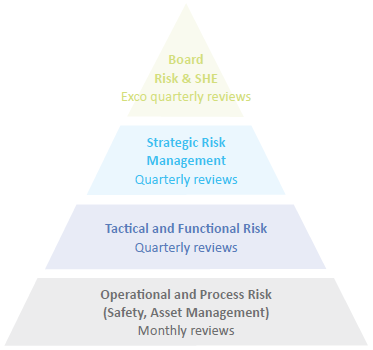
There is also a Hulamin Risk Management Committee, a sub- committee of the Hulamin Executive Committee, accountable to the Risk and Strategy Board Committee for designing, implementing and monitoring the process of risk management and integrating risk management into the day-to-day activities of the various departments.
The Hulamin Executive Committee, supported by management, supports Hulamin’s risk management philosophy; promotes compliance with Hulamin’s risk appetite; identifies, assesses and manages risks within their spheres of responsibility consistent with risk appetite and tolerances; and manages the implementation of risk reduction actions and appropriate internal controls.
All Hulamin employees are responsible for executing enterprise risk management in accordance with established directives and protocols.
A number of external stakeholders often provide information useful in effecting enterprise risk management, but they are not responsible for the effectiveness of Hulamin’s enterprise risk management.
Various external and internal parties provide risk assurance and compliance. The Hulamin Risk Management committee coordinates cross functional scenario teams (internal and external expert sources) to institutionalise the monitoring of scenario flags and appropriate strategic and tactical responses.
Principle Risk
The Risk Management Committee conducts a formal review of the most significant risks and the group’s responses to these risks three times a year.
The key strategic risks of the group, extracted from the group risk register, are shown in the table on pages 44 to 47. These risks have been assessed according to materiality and likelihood on an inherent and residual risk basis.
Internal control and assurance
The Hulamin board is responsible for establishing and maintaining an effective system of internal control which is designed to provide reasonable assurance that the group’s business objectives will be achieved in accordance with the group’s risk appetite.
A key element of the system of internal control is the review by assurance providers who assess the adequacy and effectiveness of the controls.
The group’s internal audit function is responsible, inter alia, for the following:
Effectiveness of internal controls and risk management
Internal audit provides a written statement annually to the board on the effectiveness of the systems of internal control and risk management.
Specialist assurance providers are used to assess the adequacy and effectiveness of controls in certain instances. These include environmental and safety audits. The output of the risk management process, in conjunction with the work of the independent assurance providers, indicates to the directors that the controls in place are adequate and effective. This assurance recognises that the organisation is dynamic and that at any point in time there are new areas of risk exposure which may require management attention. As such, there is a continual focus on ensuring that the control environment is understood and maintained at the required level.
Assurance efforts are documented in the combined assurance plan.

2018 Risk Focus Summary
| Reflecting on 2018 | Status | Comment |
| Focus in risk culture and embedding risk |
Ongoing | Multi-year workpkan |
| Risk review session | Completed | |
| Risk appetite review | Completed | Clarify and explained |
| Operational risk framework | Completed | |
| Strategic risk framework and risk scenario planning |
In progress | Methodology agreed, implementation underway |
| Developed risk procedure and processes |
Ongoing | Achieved ISO 9001 and new IATF certification which included process risk management. |
| 15,5 and 2 year scenarios | Ongoing | Multi-year work plan |
| Embedding business continuity management |
Ongoing | Multi-year work plan |
2019 Focus
| Risk culture and embedding risk | ||
| 15 year scenario linked to strategic options | ||
| Advancing risk controls and KPI via process optimisation | ||
| Focus on operational risk mitigation and controls linked to KPIs |
Scenario Planning methodology integrates with Strategic Risk Management, Strategy and Business planning
Click or tap for a larger version of this image
Scenario planning is therefore embedded in the Risk management process and aligns risk management, business planning, budgeting and strategy development and execution for Hulamin. (Refer here for our external environmental assessment.)
The key risks in Hulamin’s risk register are summarised into the table below with appropriate responses.
| Enablers | |
| E1 | Transformation |
| E2 | Talent management |
| E3 | Sustainability |
| E4 | Supportive regulatory environment |
| E5 | Enterprise performance management |
| Trend | Emerging uncertainty | Subsidiary risk | Risk type | Risk response | Link to strategy and enabler | Capital impacted | Risk trend | |
|
SA economic and manufacturing performance Weak economic climate in South Africa. Political uncertainty, unclear policy direction. |
1. Sovereign rating downgrade by rating agencies of local-currency denominated debt below investment grade. | Dramatic weakening of currency resulting in short-term liquidity constraints. | THREAT/OPPORTUNITY |
|
  |
Financial | Increasing | |
| 2. Low growth in the local market. | Low economic growth. Constrained local market demand for aluminium semi-fabricated products. | THREAT |
|
|
Financial | Increasing | ||
| Potential withdrawal of foreign investment. (Key customers withdraw from South Africa). | THREAT |
|
E4 |
Financial
Social/relationship |
Stable | |||
| Reduced investment in and/or failure of
infrastructure:
|
THREAT |
|
E4 |
Manufactured/
Natural |
Stable | |||
|
Differential access to global markets Global oversupply of aluminium semifabricated products, driven by continued capacity investments in China
|
3. Increased competition in global and local markets for market share. |
Rolling margins in key product
categories continue to decline in USD terms. |
THREAT |
|
 |
Financial/
Social/relationship |
Increasing | |
| 4. Increased relevance of access to required technology and skills to develop products of the future. | Inability to develop new high value, niche products to improve business profitability and long-term sustainability. | THREAT |
|

E2 |
Intellectual/
Human |
Stable | ||
|
Differential access to global markets Growing trend in protectionist trade policies around the world and support to local manufacturing industries. |
5. Chinese aluminium producers get closed out of key markets such as USA through punitive tariff protection measures. |
Hulamin gains an advantage over Chinese competitors to supply key markets such as USA. | OPPORTUNITY
THREAT |
|
|
Financial
Manufactured Social/relationship |
Increasing | |
| Competition in South Africa from low cost countries increases substantially. | THREAT |
|
E4 |
Financial
Manufactured Social/relationship |
Increasing | |||
| 6. South Africa’s preferential trade access into key developed markets is reviewed. | Loss of competitive advantage relative to other exporters into developed markets. | THREAT |
|
E4, E2 |
Social/relationship
Financial Manufactured |
Increasing |
| |
Drive cash-flow to earn the right to invest |
| |
Build capabilities |
| |
Implement the strategic business model |
| Trend | Emerging uncertainty | Subsidiary risk | Risk type | Risk response | Link to strategy and enabler | Capital impacted | Risk trend | |
|
SA Economic and manufacturing performance Economic activity curtailed by energy scarcity due to delayed investment in infrastructure and production/conversion capacity. |
7. Energy scarcity in South Africa. |
Inconsistent supply of and increasing cost of electricity. |
THREAT |
|
E4 |
Manufactured
Natural Social/relationship |
Increasing | |
| Uncertainty in sustainability of Hillside smelter. | THREAT |
|
E4 |
Financial
Social/relationship Social/relationship |
Increasing | |||
|
Climate change and social responsibility Accelerating impact of climate change, and increasing global environment regulations. |
8. Local and international resolve towards low-carbon economy. |
Introduction of Carbon Tax in
South Africa curtailing manufacturing growth. |
THREAT |
|
E4, E3 |
Natural
Financial Social/relationship |
Increasing | |
| 9. Water scarcity. | Disruption to manufacturing operations. | THREAT |
|
E3, E4 |
Manufactured
Natural Social/relationship |
Stable | ||
| Global geo politics and SA economic manufacturing performance
A weakening of the US dollar, whilst at the same time South African political stability improves, supporting foreign investment and growth, which results in a materially stronger Rand. |
10. South African Rand strengthens against the US Dollar and remains at a stronger level for an extended period. | Significantly stronger Rand results in major negative impact on Hulamin’s profitability. | THREAT |
|
|
Financial
Manufactured |
Increasing | |
| Hulamin capability
Increasing proliferation of computing power, data and new digital technologies resulting in the transformation of manufacturing capabilities and value chain collaboration. |
11. Build capabilities to use digital technologies to improve business value. | Leverage product and process know-how, achieve production efficiencies and cost reduction, improved agility and closer customer collaboration and service improvements. | OPPORTUNITY |
|
E2 |
Manufactured
Intellectual |
Increasing |
| |
Drive cash-flow to earn the right to invest |
| |
Build capabilities |
| |
Implement the strategic business model |
The following key enablers and capability build projects were identified as key risk mitigating requirements for Hulamin in any of the future scenarios.
| (Cluster A) Enablers |
Description |
| 1. Transformation (C8 Transformation, social and political) |
The re-enforcing Hulamin circle of synergy embodies the Hulamin vision of driving value to all stakeholders, whilst contributing to a better, more inclusive world.
Hulamin is increasing its preferential procurement score and enterprise supplier development programmes as well as focusing on its skills development and employment equity objectives. |
| 2. Talent management (C5 Hulamin capability) |
The Hulamin Talent Programme (H-TUP) journey provides Hulamin with an intimate knowledge of talent capabilities and gaps, enabling strategic talent decision making in a Sociotechnology disrupted world where people and skills become the ultimate differentiator.
Hulamin is reshaping our approach to managing talent, through stimulating our leadership thinking and enabling our ability to utilise talent optimally as well as extract more from our people. |
| 3. Sustainability (C7 Climate change and social responsibility) |
“Green” is good for Aluminium and Aluminium is good for “Green”.
Globally, corporates, consumers and governments are becoming more aware of and concerned with environmental sustainability and carbon footprint. This is causing rapid trend shifts globally towards “greener” technologies such as renewable energy sources, electric vehicles and recycling. Hulamin has established an Environmental Sustainability Committee to consider these various issues and to develop an environmental sustainability strategy and policy to address these various emerging requirements. |
| 4. Supportive regulatory environment (C2 SA economics and manufacturing performance) |
Strategic positioning of Hulamin as a brand, a strategic player and key partner in the Aluminium Value Chain in South Africa is a crucial requirement to compete in a globalised world. The development of a transformational Aluminium Agenda for the country as a key contributor to the GDP and a creator of sustainable jobs in and around local communities is core to our collaboration with DTI and government. |
| 5. Enterprise performance management (EPM) (C5 Hulamin capability) |
This is a key enabler to the execution of the business plan. The EPM programme is extended to support standardised process capability with information/analytics at the core of EPM. The IT and Digitisation programme enables EPM and will be a key driver of medium-term cash flow delivery and long-term positioning to enable the “New Hulamin” vision execution. |
| (Cluster B) Strategic capabilities |
Description |
|---|---|
| 6. Technology, research and innovation (R&I) (C5 Hulamin capability) |
To achieve Hulamin’s margin growth aspirations requires niche market re-positioning. This requires Hulamin to invest in the development of its technology and R&I capability. Hulamin will invest in its capability and resources to expand the current activities and focus on this critical function. |
| 7. New product/market development (C5 Hulamin capability) |
Market development is key for the long-term sustainability and success of Hulamin and many opportunities exist in markets that Hulamin does not currently supply directly to, but has the required core capabilities and market access differentiation.
Hulamin’s programme include developing innovation and product development capabilities in three horizons: 1. Provide technical/innovation support for existing product mix 2. Product innovation to meet customer requirements in new high value/growth niches 3. New innovation and business models, leveraging core capabilities |
| 8. Information technology and digital (C5 Hulamin capability) |
A digital innovation strategy can unlock many opportunities in current operations, while positioning Hulamin for global competitiveness across its operations and the value chain from suppliers to customers. Hulamin is kicking off a digitalisation programme that will seek to leverage emerging technologies to achieve these ambitions. |
| 9. Integrated business planning (C5 Hulamin capability) |
With the increased demands for on time delivery from end user customers, niche product positioning, and the additional flexibility required to respond to customer needs, Hulamin’s sales and operations planning capability and systems requires investment and enhancement. A number of initiatives have been commenced to meet changing customer requirements and increased manufacturing and planning complexity. |
Cluster A: refer link to “Our strategic response”, Pillar 2, “Building capabilities” , set out here.
Cluster B: refer link to “Unpacking the strategy”, set out here.
Hulamin also identified a number of strategic options, most of which are already under evaluation and development as part of our longer term strategy, that will make Hulamin more robust under the different scenarios.
The rationale for these strategic options are described below.
| (Cluster C) Strategic options |
Rationale |
| 1. Importance of Pietermaritzburg simplification and rolled products niche finishing investments and strategic repositioning |
Pietermartizburg Rolled Products strategic repositioning is relevant to all scenarios: i.e. a “No regret” move to lower our cost base, simplify our product range and allowing a more niche higher value product range |
| 2. Development of a trading model with partners | A trading model is particularly important to compete in a globalised world where we must offer lower cost supply, in addition to our differentiation on customer service and digitised technical process capabilities |
| 3. Establishment of alliances and partnerships | A global set of partnerships and alliances is most important in a polarised world, especially when SSA growth is low, but also to de-risk Hulamin from volatile markets and environmental/social threats |
| 4. Establishment of SSA manufacturing footprint | SSA will become more important in the longer term, especially when South Africa is not growing significantly |
| 5. Downstream capability investment | Downstream investments is relevant in most scenarios, especially in globalised trading environment and over the longer term when technology threats and new market opportunities such as Electric Vehicles become significant |
Cluster C: refer link to “Our strategic response”, Pillar 3, “Implement strategic business model changes” set out here.

