



 Previous
 Next
NextNatural capital
Click or tap for a larger version of this image


NATURAL RESOURCES WE ARE RELIANT ON
The Group relies on gas, water and electricity (carbon-intensive resource) throughout its production process.
Aluminium smelters are heavily reliant on electricity to produce primary aluminium. The mid- and downstream aluminium industries are reliant on primary aluminium for its production process. This high usage of electricity by the smelters is therefore an indirect capital on which the Group is reliant.
DECREASING OUR RELIANCE ON KEY RESOURCES
Aluminium is infinitely recyclable. By recycling aluminium, the initial energy intensive process is eliminated. There is an increasing availability of aluminium scrap, including used beverage cans, in the local market. Recycling scrap creates prospects of improved economic returns for the mid- and downstream industry; and the collection and recycling industry creates additional employment.
At the same time we are continuously striving to reduce energy consumption through improved efficiencies and waste management.
Intensity against 1 ton of production
| Carbon footprint (tons CO2e) |
Electricity consumption (KWh) |
LPG consumption (GJ) |
Water consumption (Kℓ) |
|
| 2016 | 1,76 | 1 274 | 6,58 | 2,66 |
| 2017 | 1,68 | 1 241 | 6,55 | 2,49 |
| 2018 | 1,52 | 1 172 | 7,53 | 2,52 |
OUR Approach to minimise environmental impact
To further our environmental goals a formalised business model is being developed to manage and reduce our environmental footprint. Through setting up the structural changes required to make lasting change to the use of natural capital it was recognised that financial and risk consideration were intimately connected to resource efficiency. The development of structures to achieve realistic resource efficiency targets would be beneficial for all these aspects within the organisation.
CARBON FOOTPRINT
Many of our customers are very aware of climate change and have formal programs to reduce the carbon footprints of their products by collaborating with their suppliers and customers. We assist our customers by supplying carbon footprint information and other environmental sustainability issues from the four manufacturing sites in South Africa that are under our operational control.
The group has further reduced absolute Carbon emissions for the 2018 production year, in spite of increasing production.
Hulamin continues to monitor the growing requirements in carbon footprint reporting and takes action, where applicable, from questions posed by the Carbon Disclosure Project which has challenged industry with setting significant carbon reduction standards.
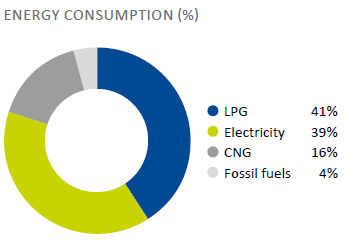
ENERGY CONSUMPTION
Hulamin’s energy performance per unit ton improved in 2018 on that of our previous record in 2017. The comparison of the 2018 data with 2017 in terms of production throughput and energy consumption shows:
- Production output increased by 4.1%,
- Energy consumption increased by 1.7%, and
- Energy intensity decreased by 2.3%.
Gas
The current year under review represented the first year during which all planned furnaces had been converted from liquid petroleum gas (LPG) to compressed natural gas (CNG). As a result CNG consumption as a percentage of the energy mix increased by 68% while LPG consumption decreased by 24%. This change in Hulamin’s energy mix has had positive effects on greenhouse gas emissions as natural gas has a lower carbon footprint than LPG.
Hulamin continues to have three melting furnaces on the Campsdrift site that continue to consume LPG. During 2018 three failures led to a decrease in the efficiency of the melting furnaces resulting in the excess consumption of LPG.
The efficiency of the transfer of liquid metal from the recycling furnace has been improved by increasing the volume of metal, from eight to ten tons, transferred at each pour. This improvement has been achieved by relining the crucibles with a thinner refractory, without loss of insulation performance. This in turn ensures more molten metal is delivered into the main melters, reducing their energy needs.
Electricity
Electricity consumption decreased by 1.1% largely attributable to the continued success of the variable speed drive (VSD) project, which continues to see implementation. During the period under review 18 147 GJ was saved due to the installation of VSD.
The projects to capture consumption data accurately and match this to the tons produced continued through 2018. Significant progress has been made with the installation of power meters at machines, the development of an industrial network to support the uninterrupted transfer of data and the installation of IT systems to support problem solving and decision making.

WATER
The water consumption per unit production continues on a positive downward trend and has dropped in 2018 to 40% below 2010 levels. Water consumption levels have decreased per unit to the lowest levels since 2011 mostly through awareness campaigns and identified wastages.
The capital expenditure for the largest potential water savings project has been approved. This Campsdrift Remelt Cast Water Recycling plant will be installed by April 2019. The objective for this plant is to recycle 80 000 litres per day from the cast water system for use in the cooling towers.
Hulamin recognises that South Africa is a water scarce country and we aim to continually set aggressive water consumption targets.

RECYCLING
Scrap metal recycling
In 2018, Hulamin continued to grow the benefits from its Campsdrift Recycling centre, which is designed to efficiently remelt light gauge and coated aluminium scrap streams and enable the recycling of post-consumer scrap such as used beverage cans (UBCs). The Recycling centre supplied the Remelt facility with an additional
43 000 MT of liquid metal, of which 27 000 tons was from post- and pre-consumer scrap, representing a 27% increase on 2017. This directly replaces the requirement for primary metal.
Aluminium scrap Hulamin is unable to use is recycled by appropriate third party users. However, in the majority of cases the recovered aluminium is fed straight back into our Remelt facility in a closed-loop system.
During 2018, Hulamin continued with its support of the recently formed producer responsibility organisation, Metal Packaging South Africa (METPAC-SA), where the focus was on preparing an Industry Waste Management Plan in response to the Department of Environmental Affairs call for plans.
Waste recycling
Dross is a natural waste by-product of the aluminium melting process. Hulamin has for many years outsourced the service of recovering aluminium from the dross generated at our remelt, recycling and other furnaces. Prior to 2016, the resulting waste stream (salt cake) had been going to landfill. From 2017 and continuing into 2018, Hulamin ensured that salt cake was sent to a recycler to beneficiate into a range of end-user products, thereby avoiding landfilling.

